Monday, May 08, 2006

People's Art

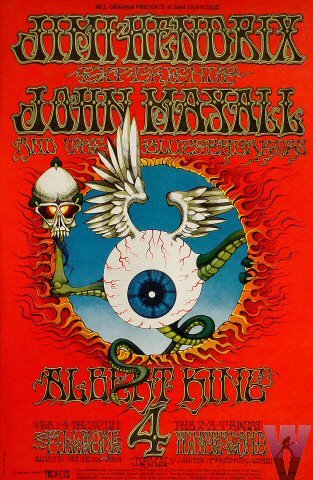
I miss the old psychedelic art of the 60's


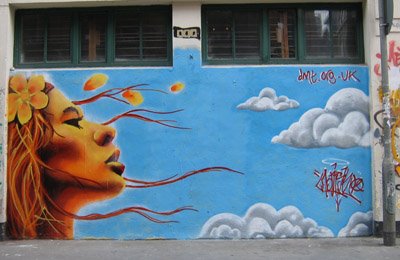
But, I love what street artists are doing today in the present context. Following are some examples:


Here is a beautiful spray can mural............


Here is a piece involving stencil Art.....


Then there is this wonderful spray can mural done by Blocked Nozzle Crew from London.....

Sunday, May 07, 2006

Comedy is a Powerful Tool


If you haven't seen it, please follow this link to see Stephen Colbert, of the "Daily Show", satirizing the Bush administration, the mainstream media and the rest of the Washington establishment while they all sit in the audience of the White House Correspondents Association Dinner.

It is pure genius and balls.

Wednesday, May 03, 2006

Killer Sound


Colombian musicians turn guns into guitars to make music - as well as a point.
By Kevin Sites, Mon Apr 24, 1:55 PM ET
Email Story IM Story


BOGOTA, Colombia - It's not long after you enter the world of Cesar Lopez that you realize he doesn't color inside the lines.

He is a classically-trained musician and composer who studied at Colombia's best conservatory. But instead of concert hall performances he chooses to play his music on the streets of Bogota. He writes all of his songs on air-sickness bags he collects during his travels.

"It's appropriate," he says, "because I feel I'm vomiting up what I have inside me."

But despite the description, the music he composes and plays is haunting and beautiful — hardly repulsive.

His comfortable Bogota apartment is filled with the tools of his trade, a baby-grand piano, guitars, amps — as well as the evidence that his subversively creative mind has few boundaries.

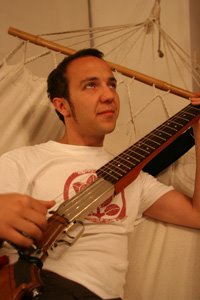
Near the piano, on a black stand that resembles a bipod, sits a Winchester lever action rifle. On its polished barrel are four hash marks, representing, says Lopez, the four people killed by it.

But there's much more to the gun than its history: six metal guitar strings stretch from the mid-point of its wooden stock, across the loading chamber, past the fret board threaded over the weapon's barrel, ending at a guitar neck flaring past the muzzle.

It's part of project in which Lopez transforms weapons of war into instruments of killer sound, using them in a kind of political performance art.

"What we want to create is an invitation to an attitude of change," he says. "It says a lot of different things — but the main idea is that weapons can be changed from an object of destructiveness to an object of constructiveness."

When he says we, he means the other 100 or so members of a group calling themselves the Battalion of Immediate Artistic Reaction — musicians and political activists, tired of Colombia's four-decade old war of attrition, committed not only to making music, but also making a point.

Using Internet meet-ups, the battalion mobilizes every time there is some kind of guerrilla attack in Bogota, heading out into the streets to serenade the victims with soothing music.

It was during the 2003 bombing of the El Nogal nightclub which killed 36 people in the capital's trendy Zona Rosa district that Lopez got the idea for turning guns into guitars.

"We were playing our music on the streets near the club," he says, "when I noticed that a soldier was holding his rifle the same way I was holding my guitar."

The prototype hangs on Lopez's wall, but the design has evolved.

"In the first one," he says, pointing out the strings suspended above the gunstock, "the guitar isn't well integrated with the gun. But it's better now. The gun is in service to the guitar, which is the idea."

Lopez says he gets the guns through an anti-land mine group connected to Colombia's peace commissioner's office. Most of the firing components are removed so it can no longer be fired.

Then a guitar maker adds the fretboard, strings and neck as well as an input for the electric amp.

"Violence fears love because it is stronger," Lopez says, strumming the gun guitar on a hammock strung between two walls of his living room. "Violence fears my voice because it goes beyond death."

Only a few dozen of the guitar guns have been manufactured so far, most being used by members of the Battalion when they respond to attacks.

But I wonder if those who just suffered from violence would really want to be serenaded by musicians playing guns.

"The attitude of most people is very good, except at airports," he laughs. But there are definitely critics.

"It's been very difficult to explain to the military the reason for a campaign like this," he says. "They don't really understand how a gun can be turned into a guitar."

And is there the potential that one of Colombia's many armed groups could use the gun guitar concept as a kind of Trojan horse — pretend they are a member of Lopez's Battalion of Immediate Artistic Reaction — but arrive in public wielding real guns instead of decommissioned ones?

Lopez nods his head. It's a question he's considered many times before.

"This is my nightmare," he says, "that's why we've been very careful to make sure the weapons are decommissioned and who we give them to. But yes, people could be killed."

Regardless, he believes real change requires risk. And this cause, he says — ending Colombia's cycle of gun-related violence — is worth it.

Besides, the transformation isn't just for show. The gun guitars truly have a killer sound, according to Lopez, ranging from ballads to, appropriately enough, heavy metal.

He and singer Adriana Luce demonstrate by performing in his living room — an untitled, ethereal work which belies the guitar's vestiges of its past.

Lopez says he just received a dozen AK-47 assault rifles, the world's most ubiquitous automatic weapon, from the peace commissioner's office, and is having them made into guitars.

When they're completed he plans to give them to high profiles musicians such as Shakira, Santana, Paul McCartney and Carlos Vivas, as well as some political and religious leaders like the Dali Lama.

However, Lopez says his recently received a letter in an incredulous tone from a member of the Dali Lama's staff, wondering why anyone would want to give the Buddhist leader a gun — regardless of what's attached to it.

Lopez says he'll try to make the explanation clearer.

In the meantime, he's also at work on another project, putting together what he calling the Experimental Reconciliation Group — a band made up of seven musicians from ex-members of Colombia's left wing guerrilla groups, right wing paramilitaries and even city gangs.

"The idea is to show that people of different political beliefs and backgrounds can work together," he says. "But they'll only be allowed to discuss music."

Optimistically, Lopez says the band will be ready to perform by Aug. 5, even though he hasn't even identified all the members yet.

All of this, he says, is about making positive changes for Colombia, reducing the violence, and teaching people to live together — an ambitious program for someone who could be filling concert halls with enchanting music.

"That's my big question right now," he says, "why I went this route. It's a gamble and I wonder if it will actually end up serving other people."


Listen to or download tracks from Lopez's "Alas de Prueba II" album:"Sin Respuesta""Eterna Presencia""Para Cristina"
To download the entire album directly to your computer's music player, click here.
To learn more about Cesar Lopez and the Battalion of Immediate Artistic Reaction, and to hear more music, visit www.cesarlopez.org.
Tuesday, May 02, 2006

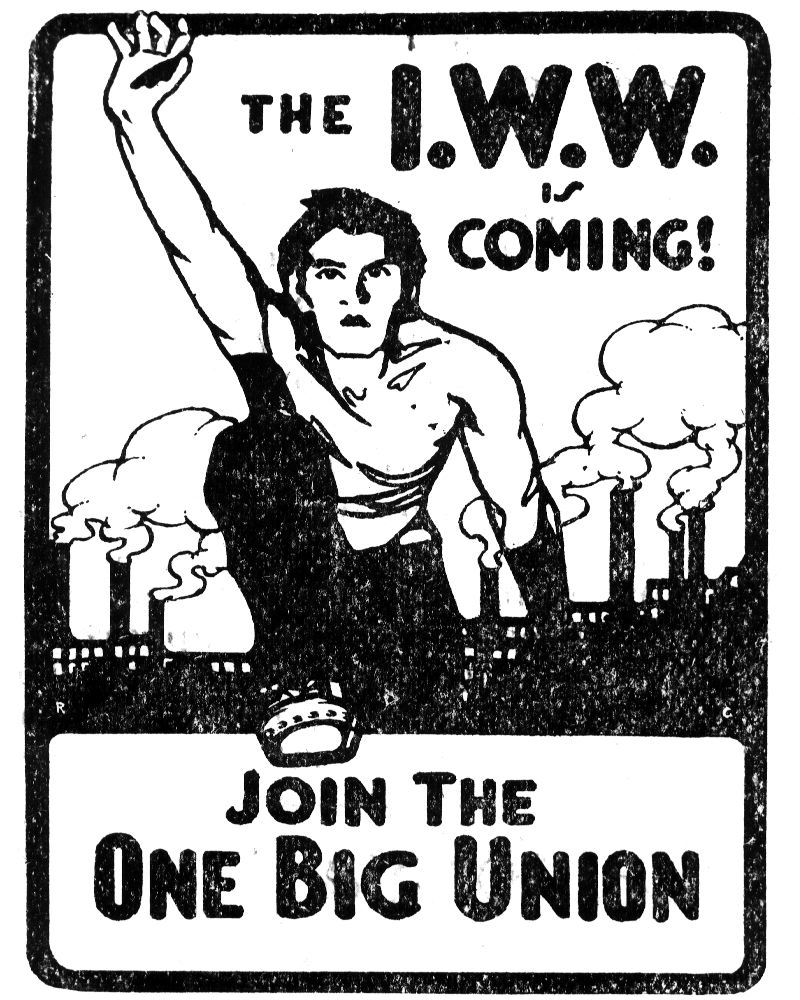
The Roots of May Day


Today's marchers are liberals' best hope.

By Nelson Lichtenstein

Posted Monday, May 1, 2006, at 4:10 PM ET


Today's May Day marches are putting millions on the street and have politicized more people than anything since the height of the civil rights movement. Like every other massive social protest in American history, the events have generated their share of fear. Democrats and some leaders of D.C.-based immigrant groups worry that the call to boycott work and shut down Latino-dependent businesses will generate a backlash. Republicans and nativists see them as un-American.


But all this is beside the point, a tiff that misses the marches' transformative impact. These May Day demonstrations and boycotts return the American protest tradition to its turn-of-the-20th-century ethnic proletarian origins—a time when, in the United States as well as in much of Europe, the quest for citizenship and equal rights was inherent in the fight for higher wages, stronger unions, and more political power for the working class.


Because today's marches are on a workday, they recall the mass strikes and marches that turned workers out of factories that convulsed America in the decades after the great railway strike of 1877, the first national work stoppage in the United States. Asserting their citizenship against the autocracy embodied by the big railroad corporations, the Irish and Germans of Baltimore and Pittsburgh burned roundhouses and fought off state militia in a revolt that frightened both the rail barons and the federal government. Hence the 19th-century construction of all those center-city National Guard armories, with rifle slits designed to target unruly crowds. The protesters wanted not only higher pay and a recognized trade union but a new birth of egalitarian freedom. Indeed, May Day itself, as an international workers holiday, arose out of a May 1, 1886, Chicago strike for the eight-hour workday. The fight for leisure—clearly lost today—was a great unifying aspiration of the immigrant workers movement a century ago with its slogan, "eight hours for work, eight hours for sleep, eight hours for what we will."


The largest mobilization of immigrant workers in U.S. history occurred in 1919, when President Woodrow Wilson's rhetorical celebration of self-determination and "industrial democracy," or self-rule at the workplace, echoed across steel districts from Homestead, Pa., to Gary, Ind. Strike organizers printed their handbills in 15 different languages. Immigrant churches and working-class lodge halls served as soup kitchens. The strikers called the mounted police "Cossacks." All these eruptions, which would successfully Americanize millions of immigrants in the 1930s, blended trade unionism, ethnic self-consciousness, and the demand for full citizenship. That unity proved essential for a long season of New Deal hegemony. And that's why this spring's awakening of a new generation of immigrant working-class half-citizens holds such promise for liberals.


The last of these great labor-strike demonstrations came in 1947. On an April workday, the United Automobile Workers flooded Detroit's Cadillac Square with more than a quarter million of its members to protest congressional enactment of the Taft-Hartley Act, which curbed union strike power and disqualified radicals from labor leadership. Most laborites called Taft-Hartley a "slave labor law." Then as now, the leaders of the demonstration were divided over tactics. The left, and not just those oriented toward the Communists, wanted to shut down the factories so that American unions could deploy, as one top UAW officer put it, "the kind of political power which is most effective in Europe." More cautious unionists, led by UAW President Walter Reuther, sought a huge demonstration but one that began only after workers clocked out for the day. Capitalizing on these internal divisions, and on the early Cold War hostility to labor radicalism and political insurgency, the auto companies took their pound of flesh. They fired key militants and cut off the tradition of white, working-class strike demonstrations in industrial cities for the rest of the 20th century.


For our generation, as for the one before it, the idea that we might change the conditions of work life and the structure of politics has seemed either radical fantasy or Parisian self-indulgence. Celebrations of May Day, the holiday that embodies that imagined link, have been consigned to the most self-conscious and marginal radicals. In 1958, President Dwight D. Eisenhower proclaimed May 1 "Law Day" so as to snuff out any proletarian embers that might have continued to smolder through the Cold War.


The 1960s civil rights and anti-war movements kept their distance from workplace actions, which became the province of an increasingly stolid and constrained trade unionism. The protests of that era were almost always held on weekends. The 1963 March on Washington, where Martin Luther King Jr. gave his "I Have a Dream" speech, took place on a sweltering Saturday afternoon. There were plenty of protest signs paid for by the union movement, but no factories shut down that day. The same is true of the big anti-war marches, and American feminists and gay-rights advocates have continued that tradition. The linkage between workplace protest and civil engagement has been broken—one reason that the boycotts and work stoppages today seem so novel and controversial.


When weekday work stoppages did take place, their marginality, and even alienation, from mainstream America was revealing. Arab workers put down their tools in June 1967 to protest U.S. support of Israel in the midst of the Six Day War. Millions of black workers left work when they learned of MLK's assassination on April 4, 1968, but black power efforts to use the strike to build a radical movement on the assembly lines largely failed in Detroit a year later. Today's marches and boycotts are restoring to May Day something of its old civic meaning and working-class glory. Even some of the most viciously anti-union employers of Latino labor, like Perdue, Cargill, and Tyson Foods, kept their factories closed. As in the crucial struggles that began more than a century ago, today's marches have forged a link among working-class aspiration, celebrations of ethnic identity, and insistence on full American citizenship. It's an explosive combination. And it could revive and reshape liberal politics in our time.

Nelson Lichtenstein is professor of history at the University of California, Santa Barbara, where he directs the Center for Work, Labor, and Democracy. He is the editor of Wal-Mart: The Face of Twenty-First-Century Capitalism.

Article URL: http://www.slate.com/id/2140846/

Copyright 2006 Washingtonpost.Newsweek Interactive Co. LLC