Friday, March 31, 2006

What Happened to the American Dream?


Article Published on Thursday, March 30, 2006 by the Atlanta Journal-Constitution

The Dismay of Our Elders Sums Up US
by Jay Bookman

An eerie sense of calm has settled over the nation's affairs — a dead calm.

It's not merely that the Bush administration has run aground on its own illusions. The real problem runs deeper, much deeper, and at its core, I think, lies the fact that out of fear and laziness we insist on trying to address new problems with old ideologies, rhetoric and mind-sets.

To put it bluntly, we don't know what to do, and so we do nothing.

Run through the list: We have no real idea how to address global warming, the draining of jobs overseas, the influx of illegal immigrants, our growing indebtedness to foreign lenders, our addiction to petroleum, the rise of Islamic terror . . .

Those are very big problems, and if you listen to the debate in Congress and on the airwaves, you can't help but be struck by the smallness of the ideas proposed to address them. We have become timid and overly protective of a status quo that cannot be preserved and in fact must be altered significantly.

The Republicans, for example, continue to mouth a cure-all ideology of tax cuts, deregulation and a worship of all things corporate, an approach too archaic and romanticized to have any relevance in the modern world, as their five years in power have proved.

The GOP's sole claim to bold action — the decision to invade Iraq in the wake of Sept. 11, 2001 — instead epitomizes the problem. The issue of Islamic terrorism is complex and difficult, and by reverting immediately to the brute force of another era, we made the problem worse.

Unfortunately, the Democrats don't offer an alternative. They mouth no ideology whatsoever, their imagination, ingenuity and courage apparently having petered out 30 years ago. They can't bring themselves to acknowledge that the modern litany of problems will require us to invent new roles for government, and to rework the relationships between citizens, corporations and country.

But we can't even talk about such things. Our public discourse — which ought to be the source of renewal and energy in a democracy — has been stripped of meaning, with rudeness now mistaken for eloquence and anger substituting for insight.

All that has led to a sense of helplessness atypical of the American character. In an accurate reflection of our national mood, only 29 percent in a recent Gallup Poll said they were satisfied with the country's direction, a number that can't be explained away solely by our predicament in Iraq. The Gallup numbers haven't consistently been above 50 percent since the spring of 2002, long before most Americans were even aware an invasion loomed.

But more compelling to me than numbers are the e-mails, probably dozens of them in total, that have trickled into my in-box over the past year or so from older Americans all around the country.

"I am 79 . . . I am 84 . . . I was born in 1931," they start out. "I fought with the Eighth Army in Korea . . . We lost our oldest son in Vietnam . . . My husband served in the Pacific . . . I taught school for 35 years," they continue, each recounting their personal contributions to this country and establishing their own perspective on its history.

Then comes the statement that breaks your heart. The words vary from author to author, but the sentiment does not:

"This is not the country I wanted to leave my grandchildren . . . Is this what we sacrificed so much for all those years? . . . I really don't understand how it has come to this. . . . We took for granted that in America it would always be better for the next generation, but I can't see that's the case anymore. . . . Where did we go wrong?"

These people are concerned not for themselves, but for what they may soon leave behind. And that concern for the future is all the more remarkable because it is so rare among those of us who are their children and grandchildren.

Unlike our elders, we refuse to tax ourselves to pay for our wars, our roads, our government. We elevate leaders who promise us tax cuts and free services and cheap oil and the strongest military in the world, and we shun any who dare to suggest that sacrifice might be necessary for such things.

Of course, as a nation we have faced worse. The generation that endured the Great Depression only to be hit with World War II had to confront challenges that make our own pale in significance.

But when people of that generation express sincere dismay about where we're headed today, it's gotta make you wonder.

Jay Bookman is deputy editorial page editor. His column appears Thursdays and Mondays.

© Atlanta Journal-Constitution

Thursday, March 30, 2006

I Can't Take Your Slogans No More

Can Someone Own Ancient Knowledge?


Greedy self-serving entrepreneurs our trying to own the rights to ancient spiritual and healing knowledge. It's great to see India doing something about it.

from the February 09, 2006 edition - http://www.csmonitor.com/2006/0209/p07s02-wosc.html

India: Breathe in, and hands off our yoga
Delhi builds a digital library of lore such as herbal remedies and yoga to safeguard intellectual property.

By Anupreeta Das Contributor to The Christian Science Monitor


DELHI - India's centuries-old traditional knowledge, preserved and orally passed down through generations of households, is now going digital.

Over the coming months, India will unveil a first-of-its-kind encyclopedia of 30 million pages, containing thousands of herbal remedies and eventually everything from indigenous construction techniques to yoga exercises.

The project represents a 21st-century approach to safeguarding intellectual property of the ancient variety. The Traditional Knowledge Digital Library (TKDL) aims to prevent foreign entrepreneurs from claiming Indian lore as novel, and thus patenting it.

"We do not want anyone selling our own knowledge to us," says Ajay Dua, a top bureaucrat in the Department of Industrial Policy and Planning, which oversees intellectual-property rights. "Also, we would like anyone using our traditional knowledge to acknowledge that it is from India."

These concerns are not unfounded. In the past decade, India has fought several costly legal battles to get patents revoked. The impetus for TKDL came in 1997, after India successfully managed to get a US patent on the wound-healing properties of turmeric revoked.

"This patent claimed the wound-healing properties as a novel finding, whereas practically every Indian housewife knows and uses it to heal wounds," says R. A. Mashelkar, chief of the Council for Scientific and Industrial Research (CSIR).

The innovative idea to translate and digitize all the available information on traditional medicine was a collaborative effort of bureaucrats, scientists, and intellectual-property lawyers.

"It was a way to prevent more patents from being granted. Also, it was a way of throwing the information open to the public because this traditional wealth is for the benefit of mankind," says Rajeshwari Hariharan, a partner at K&S Partners, the law firm that represented India in several high-profile patent cases, including its fight over basmati rice, turmeric, and the antibacterial properties of the neem [margosa] leaf.

Of about 5,000 patents on plant-based formulations granted by the US in 2000, 80 percent were on plants of Indian origin, says Vinod Gupta, with the National Institute for Science Communication and Information Resources.

Mr. Gupta heads a team of 150 doctors, scientists, and information-technolgoy experts who have worked on the TKDL project since 2002. Poring over ancient medical texts and punching code into computers in Delhi, they have already documented more than 110,000 formulations culled from some 100 texts belonging to the three principal systems of traditional medicine - ayurveda, unani, and siddha.

Patent officers call this information "prior art," or previously existing knowledge about the applications of a product. Normally, a patent application is rejected if there is prior art on the product. But in the patent offices of the US, Europe, and Japan, prior art is recognized only if it has been published in a journal or database.

Traditional knowledge and folklore passed down orally - or contained in ancient, inaccessible texts - are not prior art. "We therefore revisited the past and modernized it," says Gupta.

The TKDL uses complex computer software to translate formulations written in ancient and medieval Indian languages to English, French, German, Japanese, and Spanish.
The $2 million project could wind up saving India money in the long run. "It is definitely far cheaper than any litigation costs India would have to pay to fight patent battles," says Gupta.
Indian officials are recognizing an ever- widening array of traditional knowledge that may be stolen by biopirates. "You name an area, and there is an Indian product in danger of being lost to a patent," says Gupta, pointing to Indian handicraft designs, Kashmir silk, and pashmina, a premium wool derived from the Himalayan goat.

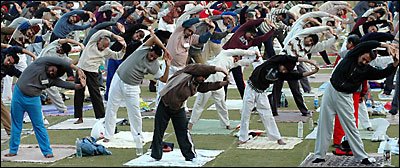
Yet many were caught off guard here when in 2004 the US granted an Indian-American yoga practitioner a patent on a sequence of 26 asanas, or physical exercises. Following the initial disbelief that anyone could claim authorship over a 5,000-year-old tradition, officials say they are finally setting up a task force with yoga guru B.K.S. Iyengar to prepare a case.

Such disputes have expanded the scope of the TKDL project. Once traditional medicine entries are completed, officials say they will focus on documenting all traditional knowledge. Already, the CSIR is creating databases on traditional Indian foods, indigenous architecture and construction techniques, and oral tribal knowledge, in what Dr. Mashelkar calls "defensive protection."

"The conversion of our [traditional] knowledge into digital format is need-based and has become essential," he adds.

Full HTML version of this story which may include photos, graphics, and related links
www.csmonitor.com Copyright © 2006 The Christian Science Monitor. All rights reserved.For permission to reprint/republish this article, please email Copyright

Wednesday, March 29, 2006


I'm still not feeling well, but wanted to allert you to this breaking NEWS!! Posted by Picasa

Tuesday, March 28, 2006


I've been sick with a flu for the last 24 hours. This is kinda like how I felt. Posted by Picasa